

Consider your day-to-day business interactions – all the emails you sent, documents you share and any type of business information you exchange between colleagues, customers or third parties – all these activities falls under the umbrella of business correspondence. As any other complex process within a business or governmental establishment, business correspondence requires proper management.
Correspondence management is of paramount importance for all organizations, government agencies and other parties that have to deal with deadlines, and seek the highest possible level of productivity, as well as an efficient control system to effectively govern the ever increasing correspondence channels. This is where correspondence management systems come into play.
Correspondences such as emails, letters, fax, invoices, and others are core to a government agency’s everyday activities. However, tracking and responding to these correspondences timely is a task.
The moment a correspondence is received, it requires an appropriate action, which could be either redirecting it to the concerned individual/ department, sending a reply or archiving it. The way these communications are managed directly impacts an organizations’ effectiveness.
According to IDC, the knowledge worker spends about 2.5 hours per day or roughly 30% of the workday searching for information.
What is a Correspondence Management System?
 While correspondence management is the process of receiving, recording, logging, appropriately processing and responding to and creating an audit trail of received correspondence. A Correspondence Management System is used to track all the incoming and outgoing business correspondence of an organization and make it available to all application users according to their roles and access.
A good Correspondence Management system provides the electronic means of storing, retrieving, and routing correspondence for review and approval. Such systems provide the capability to efficiently and effectively manage huge amount of correspondences both electronically as well as on paper, mail, fax and other traditional methods.
The Correspondence Management systems centralize and manages the creation, assembly and delivery of secure, personalized, and interactive business correspondences. It enables organizations to quickly assemble correspondence from both pre- approved and custom-authored content in a streamlined process from creation to archival.
As a result, customers get the right communication at the right time in the right way – timely, accurate, convenient, secure, and relevant. This enables businesses to maximize the value of customer interactions and minimize the costs and risks associated with a rather complex process.
Features of a Correspondence Management System

A correspondence management system (CMS) boosts productivity and efficiency by streamlining an organization’s internal and external communications, enabling officials to perform more critical tasks in a productive manner.
Some of the feature of a Correspondence Management System are as follows:
Correspondence Capture
Paper-based correspondence still forms the bulk of business correspondence. Although it is on the decline, the solution needs to have the ability to capture incoming paper-based correspondence, as well as digital ones.
Correspondence Storage
A correspondence solution needs to be able to store incoming, and outgoing, correspondence in a secure and compliant manner. Also, some of the correspondence will need to be managed in accordance with industry regulations for audit purposes.
Process Management
A correspondence management system needs to be able to route the correspondence to the most appropriate person or team in an organization to process it.
Communications Management
A solution needs to be able to produce outgoing communication, in traditional paper or in email format, and the output needs to be personalized to the needs of the person to whom it is being sent.
ECM Integration
Typically correspondence needs to be viewed within the context of an Enterprise Content Management system. Therefore the solution must have standards based integration to enable this where applicable.
Management Information
Currently organizations have limited visibility of their performance in dealing with business correspondence. The solution needs to provide this information so organizations can improve their performance as well as their customer service.
Newgen’s Smart Correspondence Management Software
Newgen’s Smart Correspondence/File Management System provides a unified platform to manage all correspondences.
Built on a low code platform encapsulating Business Process Management (BPM) and Document Management platforms, it transforms the day-to-day operations at all levels of administrative hierarchy by automating key stages of correspondence management.

A smart correspondence management system, built on a low code automation platform providing contextual content services (ECM) and intelligent digital automation (BPM) capabilities, ensures standardization, and offers scalability & flexibility to meet an organization’s requirements.
The system provides a unified view of all the correspondences, ensures information security and supports multi-channel intake of various correspondence formats. Further, BPM with its extensive integration capabilities allows for seamless integration with third-party systems and applications.
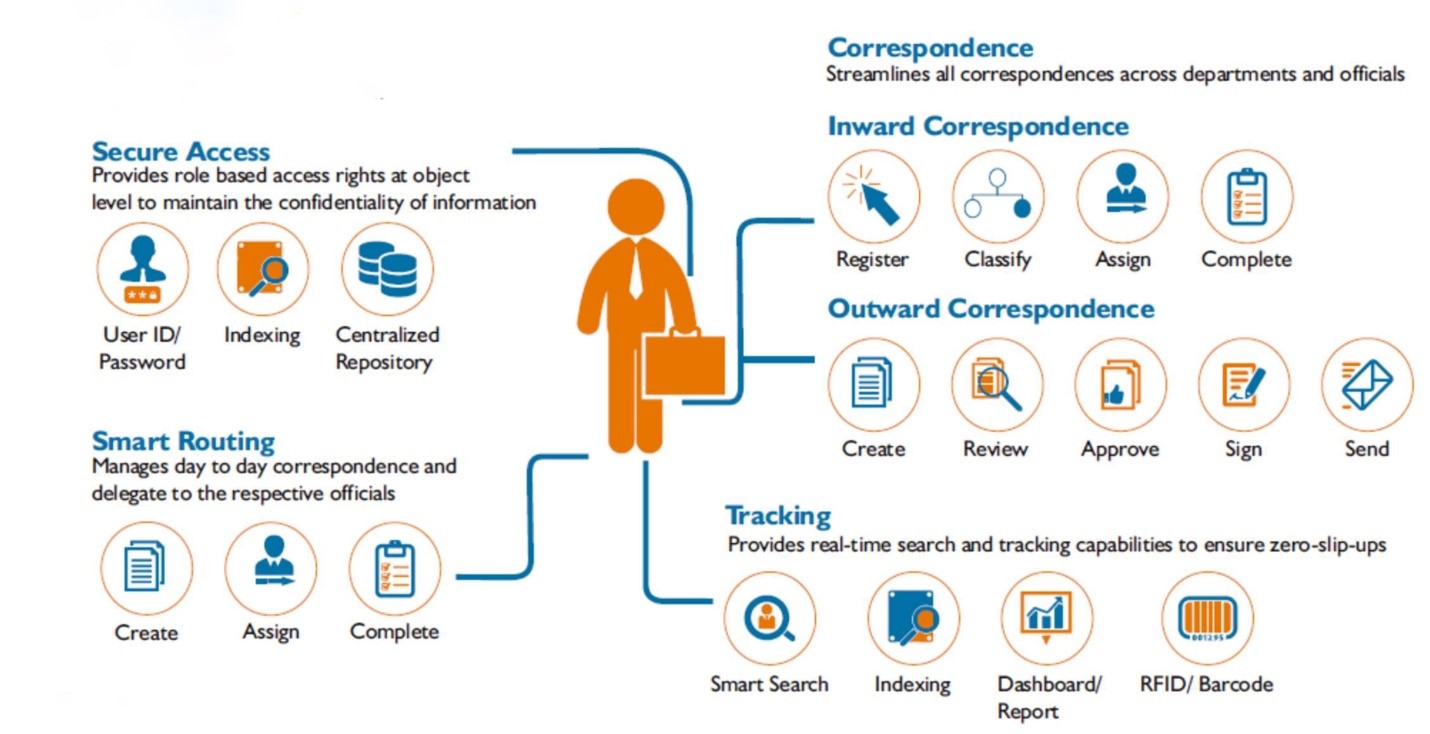
Correspondences originating in different forms and from different sources are captured and converted into electronic files/documents, which are routed to respective departmental officials. All decisions/comments/notes made by the officials are captured in the file and remain intact throughout its lifetime.
The correspondences can be archived in a central repository and accessed anytime for making informed decisions. Their tagging ensures real-time tracking and on-demand status reports, thereby ensuring complete accountability.

The solution facilitates a paperless work environment by streamlining the correspondence lifecycle from creation to archival. It enables a seamless intake of correspondences and allows users to share correspondences, internally as well as externally.
In addition, it helps organizations ensure compliance by providing complete visibility into the process. The solution also offers a centralized repository to archive correspondences, allowing users to access the right information at the right time while ensuring security.
Key Features of Newgen’s Correspondence Management Software

- Inbuilt inbox for receiving all correspondences/ files
- Electronic processes and interoperability ensuring quick decision making and service delivery
- Electronic correspondence/ file creation, management, movement and execution of key tasks such as diary entry, indexing, noting, cross referencing, search/ retrieval, etc.
- Maintenance of e-Registers – personal, divisional and departmental
- Inter-divisional interface allowing sharing of files, papers, etc.
- Electronic profile support and pre-created correspondence profiles
- White Hall File view (replica view of physical files) with note sheet and digital signature integration
- Smart search interfaces for quick access to correspondences & files
- BARCODE/ RFID integration for file and correspondences tracking
- Social and Mobile extensions that enhance responsiveness and accessibility
Benefits of Newgen’s Correspondence Management Software

- Effective transformation to less paper office environment
- Better communication and coordination among the departmental officials
- Reduced physical storage and materials costs
- Adherence with regulatory compliances
- Enhanced transparency with better monitoring and control
- Archival of files in a secured and centralized repository
Smart Correspondence Management – Need of the Hour
Managing correspondence entails supporting multiple standard operating procedures (SOPs). For instance, a correspondence may be confidential or general. It may be addressed to an official, a department or agency. Based on just one parameter, for whom the correspondence is addressed to, there can be various worksteps.
Further, for processing the correspondence, you need to capture selective metadata, ensure restricted access to correspondence or its processing, and design workflows to support delegation of authority and to perform other related activities. After processing, it’s also important to archive the correspondence for audit and compliance.
In an increasingly digital world, delivering an unparalleled customer experience is not a requirement, but rather a sustainable competitive differentiation.
For understanding how a correspondence management system can streamline your communications, please get in touch with us for scheduling a demo on this solution.